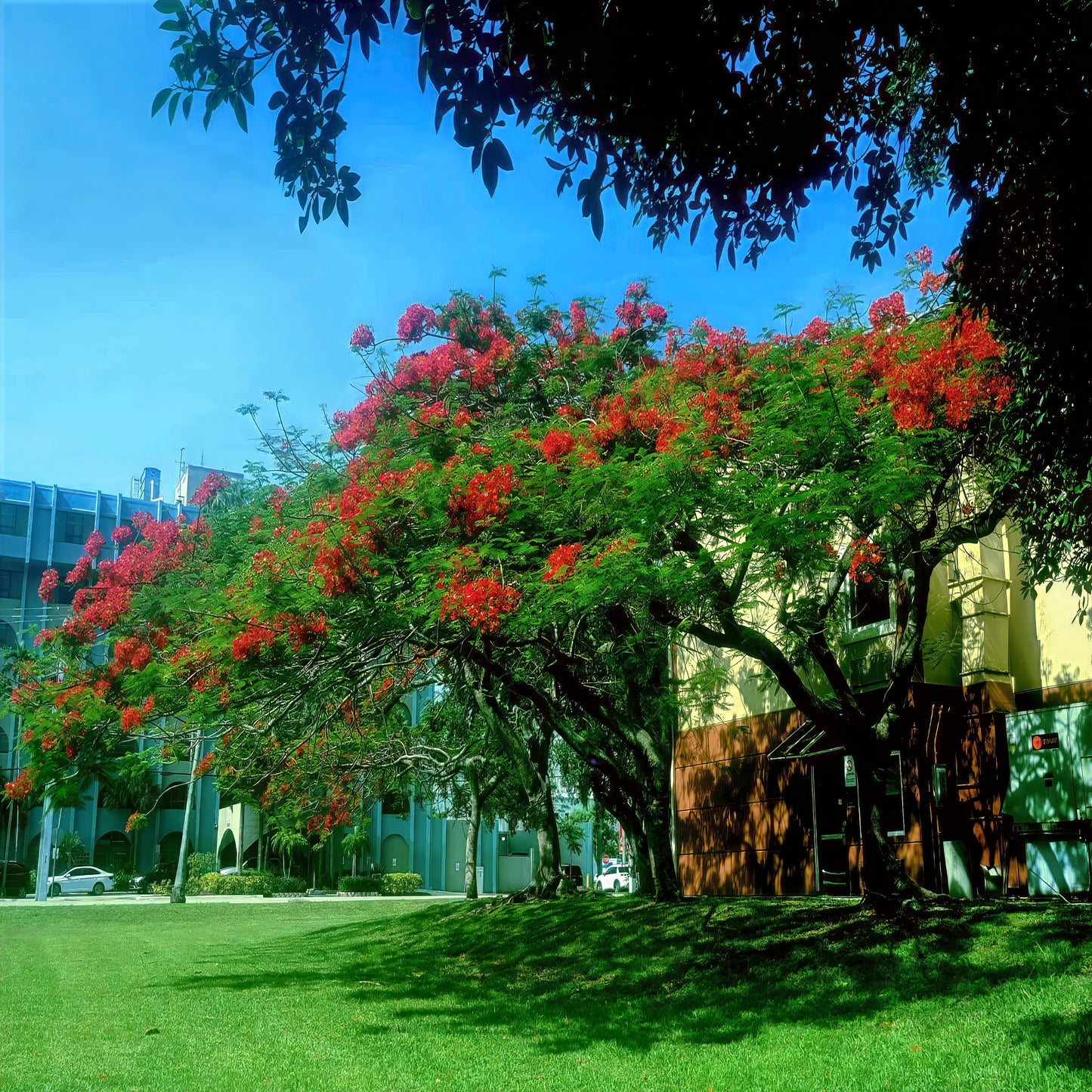
Royal Poinciana Red Flame Tree Seeds (Delonix regia) Tropical Flamboyant Flower Tree
Royal Poinciana Red Flame Tree Seeds (Delonix regia) Tropical Flamboyant Flower Tree
Couldn't load pickup availability
RED FLAME ROYAL POINCIANA TREE SEEDS (Delonix regia)
The Royal Poinciana (Delonix regia), also known as the Flamboyant or Flame Tree, is one of the most spectacular flowering trees in the world. Native to Madagascar, this tropical species is widely planted across warm climates for its intense scarlet-orange floral display and wide, umbrella-shaped canopy.
This fast-growing ornamental tree typically reaches 30–40 feet tall with an even wider spread of up to 70 feet, forming a dramatic, flat-topped canopy that provides excellent shade in tropical landscapes.
Its finely divided, fern-like leaves create a soft, lacy texture, while its large 3–4 inch scarlet flowers appear in late spring through summer. Each bloom features four spreading petals and a fifth banner petal marked with streaks of yellow and white, creating a vivid, flame-like appearance that attracts hummingbirds and pollinators.
The flowers are followed by long, flattened seed pods that can reach up to 24 inches in length, adding additional ornamental interest.
🌱 Growing & Care Information
Light: Full sun required
Soil: Well-drained soil; adaptable to most soil types
Water: Moderate; prefers consistent moisture
Growth: Fast-growing tropical ornamental tree
Climate: Best suited for tropical and subtropical regions
Royal Poinciana is widely used as a shade tree, street tree, and landscape specimen, and is especially valued for its dramatic seasonal flowering display.
🌿 Why Grow Royal Poinciana?
• One of the world’s most vibrant flowering trees
• Brilliant scarlet-orange tropical blooms
• Fast-growing shade and ornamental tree
• Excellent for large landscapes and tropical gardens
• Attracts hummingbirds and pollinators
In suitable climates, this species is considered one of the most breathtaking ornamental trees, often forming a glowing canopy of color during peak bloom.
USDA Hardiness Zones: 10–12
Flame Tree Germination:
1) Scarify the seeds by chipping the seed coats to stimulate germination by allowing water to penetrate the seeds. Use a small knife to nick the seed shells, but not too deep.
2) Place the seeds in water and bring it to a boil. Then allow the water to cool while the seeds soak for 24 hours.
3) Use a well mixed & well draining potting soil with a bit of sand added to help with drainage. Plant the seeds 1/2 inches deep.
4) Use a heated propagator mat to keep the soil at a constant 78 degrees F.
5) Keep the soil moist, not wet as that can cause them to rot.
6) As with any tropical or exotic seed, germination is erratic and never occurs at the same time. One or two seeds may sprout within 2-3 weeks, but most will germinate anywhere between 12-349 days, but by following the germination instructions, you will Greatly Speed up Germination. Don't toss out the ones that haven't as they are still good & will still germinate at a later time.
7) Periodically check them for signs of mold or fungus. If found, remove effected seeds and clean with a copper based fungicide. Then, rinse them well and place them back into a new & sterile potting mix.
Germinación del árbol de llama:
1) Escarifique las semillas picando las cubiertas de las semillas para estimular la germinación permitiendo que el agua penetre en ellas. Use un cuchillo pequeño para hacer cortes en las cáscaras de las semillas, pero no demasiado profundo.
2) Coloque las semillas en agua y llévela a ebullición. Luego deje que el agua se enfríe mientras las semillas se remojan durante 24 horas.
3) Use una tierra para macetas bien mezclada y con buen drenaje con un poco de arena agregada para ayudar con el drenaje. Plante las semillas a 1/2 pulgada de profundidad.
4) Use una estera de propagación calentada para mantener la tierra a una temperatura constante de 78 grados F.
5) Mantenga la tierra húmeda, no mojada, ya que eso puede hacer que se pudran.
6) Como con cualquier semilla tropical o exótica, la germinación es errática y nunca ocurre al mismo tiempo. Una o dos semillas pueden brotar en 2-3 semanas, pero la mayoría germinará en cualquier momento entre 12 y 349 días, pero si sigue las instrucciones de germinación, acelerará enormemente la germinación. No deseches las que no lo hayan hecho, ya que todavía están en buen estado y germinarán más adelante.
7) Revísalas periódicamente para ver si tienen moho u hongos. Si los encuentras, retira las semillas afectadas y límpialas con un fungicida a base de cobre. Luego, enjuágalas bien y colócalas nuevamente en una mezcla para macetas nueva y esterilizada.
Share