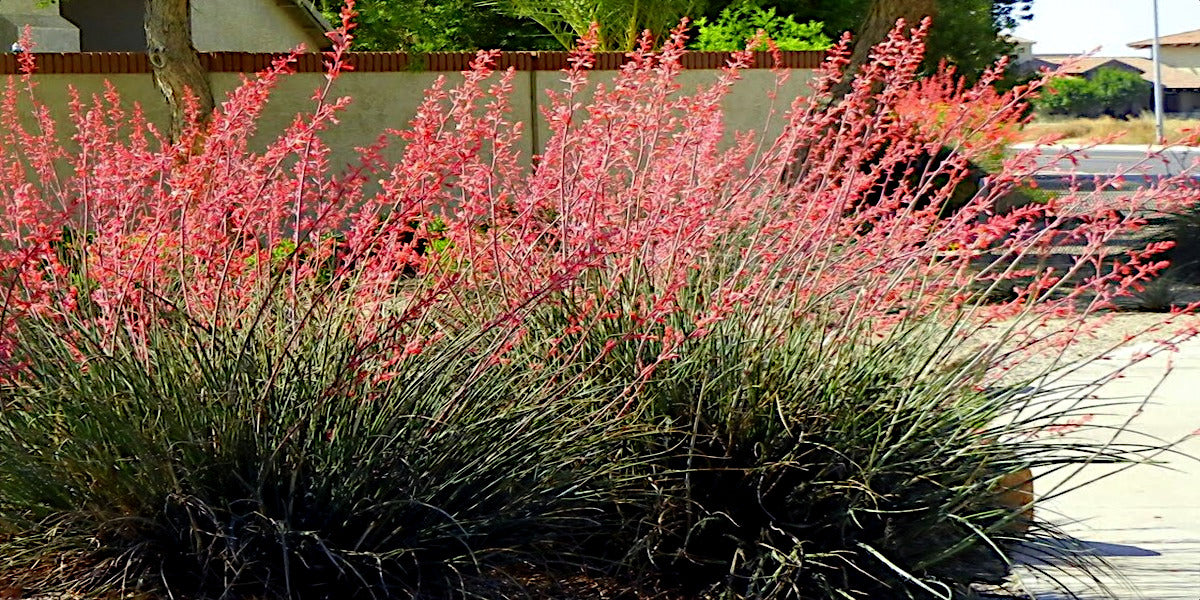
Red Yucca Seeds (Hesperaloe parviflora) Drought Tolerant Hummingbird & Butterfly Plant
Red Yucca Seeds (Hesperaloe parviflora) Drought Tolerant Hummingbird & Butterfly Plant
Couldn't load pickup availability
Red Yucca Seeds (Hesperaloe parviflora)
The Hesperaloe parviflora, commonly known as Red Yucca or Texas Red Yucca, is a highly drought-tolerant ornamental succulent native to the Southwestern United States and northern Mexico. Despite its common name, it is not a true yucca, but it shares a similar architectural form and desert-hardy nature, making it a popular choice for xeriscaping and low-maintenance landscapes.
This striking perennial forms dense clumps of narrow, grass-like blue-green leaves that remain attractive year-round in mild climates. From late spring through summer—and often well into fall—it produces tall, arching flower stalks that can reach up to 5 feet in height. These stalks are covered with tubular reddish-pink to coral-red flowers that are especially attractive to hummingbirds and butterflies.
Red Yucca is native to rocky slopes, grasslands, and desert environments, where it thrives in full sun and well-drained soils. It is extremely drought tolerant once established and can adapt to a wide range of soil types, including sandy and rocky conditions. It is also more cold hardy than many desert succulents, surviving in USDA Zone 5 with protection.
This low-maintenance species is widely used in modern xeriscape design due to its architectural form, long blooming season, and wildlife value. It can also be grown in containers and overwintered indoors in colder climates if sufficient light is provided.
🌱 Growing & Care Information
Light: Full sun
Soil: Well-draining, sandy or rocky soil
Water: Low; very drought tolerant once established
Growth: Clumping evergreen perennial succulent
Climate: Arid to temperate regions
Blooming begins in early summer and can continue for several months under ideal conditions.
🌿 Why Grow Red Yucca?
• Long blooming coral-red flower spikes
• Excellent hummingbird and butterfly attractor
• Extremely drought tolerant succulent
• Low maintenance landscape plant
• Architectural grass-like evergreen foliage
• Thrives in poor rocky soils
• Great for xeriscaping and desert gardens
• Cold hardy compared to many succulents
USDA Hardiness Zones: 5–11
Red Yucca Germination:
1) Wash a flat seed tray with soapy water and rinse in 1 part bleach mixed with 9 parts water. This removes all debris and eliminates lurking plant diseases. Allow the tray to dry completely so the soil does not turn to mud when added. If drainage holes are missing, poke them in the bottom of the tray with an ice pick. Fill the tray halfway with commercial cactus soil mix.
2) Spread the red yucca seeds evenly over the top of the cactus soil. Cover the seeds with a sprinkle of cactus soil. Use a spray bottle to mist the soil with room temperature water. Cover the tray with a piece of clear plastic to create a greenhouse effect. This keeps the humidity high.
3) It is Very Important to be sure to use a heated propagator mat to keep the soil temperature at 80 degrees F.
4) Keep the trey in bright, indirect light.
5) Remove the plastic and spray the soil daily to keep it moist, "Not Wet", then recover with plastic. If any mold or fungus is found on the seeds, wash them in a copper based fungicide and replace in new, sterile cactus starting mix.
6) Patience will be needed as the germination time can occur anywhere from 1-12 months as long as the right conditions are met. If some germinate early, don't toss the others out as they're still good. They just need a bit more time.
Germinación de la yuca roja:
1) Lave una bandeja de semillas plana con agua jabonosa y enjuáguela con 1 parte de cloro mezclado con 9 partes de agua. Esto elimina todos los residuos y elimina las enfermedades de las plantas que acechan. Deje que la bandeja se seque por completo para que la tierra no se convierta en barro cuando la agregue. Si faltan orificios de drenaje, hágalos en el fondo de la bandeja con un picahielos. Llene la bandeja hasta la mitad con una mezcla comercial de tierra para cactus.
2) Esparza las semillas de yuca roja de manera uniforme sobre la parte superior de la tierra para cactus. Cubra las semillas con una pizca de tierra para cactus. Use una botella rociadora para rociar la tierra con agua a temperatura ambiente. Cubra la bandeja con un trozo de plástico transparente para crear un efecto invernadero. Esto mantiene alta la humedad.
3) Es muy importante asegurarse de usar una estera de propagación calentada para mantener la temperatura de la tierra a 80 grados F.
4) Mantenga la bandeja en una luz indirecta brillante.
5) Retire el plástico y rocíe la tierra a diario para mantenerla húmeda, "no mojada", luego cúbrala con plástico. Si encuentra moho u hongos en las semillas, lávelas con un fungicida a base de cobre y reemplácelas con una mezcla nueva y esterilizada para iniciar el cultivo de cactus.
6) Será necesaria paciencia, ya que el tiempo de germinación puede variar entre 1 y 12 meses, siempre que se cumplan las condiciones adecuadas. Si algunas germinan antes, no deseche las demás, ya que todavía están en buen estado. Solo necesitan un poco más de tiempo.
Share