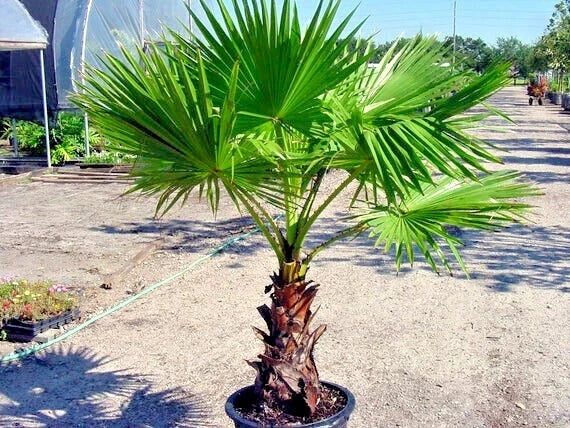
Mexican Fan Palm Tree Seeds (Washingtonia robusta) Fast-Growing Tropical Palm
Mexican Fan Palm Tree Seeds (Washingtonia robusta) Fast-Growing Tropical Palm
Couldn't load pickup availability
Mexican Fan Palm Tree Seeds (Washingtonia robusta)
The Mexican Fan Palm (Washingtonia robusta), also known as the Washington Palm, is a fast-growing, arrow-straight evergreen palm prized for its towering height and classic tropical appearance. Native to northwestern Mexico, this iconic palm is widely planted in warm climates, coastal regions, and urban landscapes where it creates an unmistakable skyline silhouette.
Under ideal conditions, Mexican Fan Palm is one of the fastest-growing palms in the world, capable of adding up to 6 feet of growth per year when young. Mature trees commonly reach 40–50 feet tall, with exceptional specimens growing 80 feet or more over time. Despite its massive size outdoors, young palms adapt very well to container growing and make striking patio or deck plants when started in pots.
This palm is highly tolerant of heat, drought, poor soils, and urban conditions. While native to desert regions, it performs best with regular watering in well-drained soil and full sun exposure. Overwatering or soggy soil should be avoided, as it can lead to root rot.
In late spring to early summer, mature palms produce long, arching flower clusters extending beyond the leaves. Small creamy-white flowers are followed by black, berry-like drupes. The fruits are technically edible, thin-fleshed, and mildly sweet, often compared to dates.
🌿 Key Features:
• Botanical Name: Washingtonia robusta
• Common Name: Mexican Fan Palm, Washington Palm
• Plant Type: Fast-growing evergreen palm tree
• Growth Rate: Very fast (up to 6 ft per year when young)
• Mature Height: 40–80+ feet
• Foliage: Large fan-shaped green fronds
• Flowers: Small creamy-white flowers in long clusters
• Fruit: Black berry-like drupes
• Uses: Tropical landscaping, patios, containers, urban plantings
• Sun Exposure: Full sun to partial shade
• Soil: Well-drained sand to loam; tolerates poor soils
• Water: Moderate; drought tolerant once established
• Cold Tolerance: Down to ~20°F briefly (leaf damage below ~23°F)
• USDA Zones: 8a–11
Whether grown as a dramatic landscape centerpiece or started as a container palm for patios and decks, the Mexican Fan Palm delivers classic tropical impact, rapid growth, and exceptional durability in warm climates.
Fan Palm Germination:
Due to the often slow and uneven germination of Tropical & Exotic seeds, Patience is Needed.
Follow these steps to get more even & faster rates of germination.
1) Rough up the outer shell of the seed with rough grit sand paper to allow water to permeate the shell.
2) Pour boiling hot water over palms seeds. Repeat daily & Keep them in water for 7 days, changing the water daily.
3) Sow 1/2” Deep, Using a Heated Propagator, keep the soil warm around 85 F is optimal. Keep moist. (Not too wet).
4) Periodically inspect the seeds to check for mold or fungus. If found, clean seeds with a copper based fungicide, rinse them really well, and replant them in a new and sterile potting mix.
4) Be patient & expect germination to occur anywhere between 2-9 months as germination with Palms, or any Tropical seeds are well known to be erratic.
Germinación de la palma de abanico:
Debido a la germinación a menudo lenta e irregular de las semillas tropicales y exóticas, se requiere paciencia.
Siga estos pasos para obtener tasas de germinación más uniformes y rápidas.
1) Lije la cáscara exterior de la semilla con papel de lija de grano grueso para que el agua penetre en ella.
2) Vierta agua hirviendo sobre las semillas de palma. Repita a diario y manténgalas en agua durante 7 días, cambiando el agua a diario.
3) Siembre a 1,27 cm de profundidad. Con un propagador calefactado, mantenga la tierra a una temperatura óptima de alrededor de 29 °C. Manténgala húmeda (no demasiado mojada).
4) Inspeccione periódicamente las semillas para detectar moho u hongos. Si los encuentra, límpielas con un fungicida a base de cobre, enjuáguelas bien y vuelva a plantarlas en una tierra para macetas nueva y estéril.
4) Tenga paciencia y espere que la germinación ocurra entre 2 y 9 meses, ya que la germinación de las palmas o de cualquier semilla tropical es bien conocida por ser errática.
Share