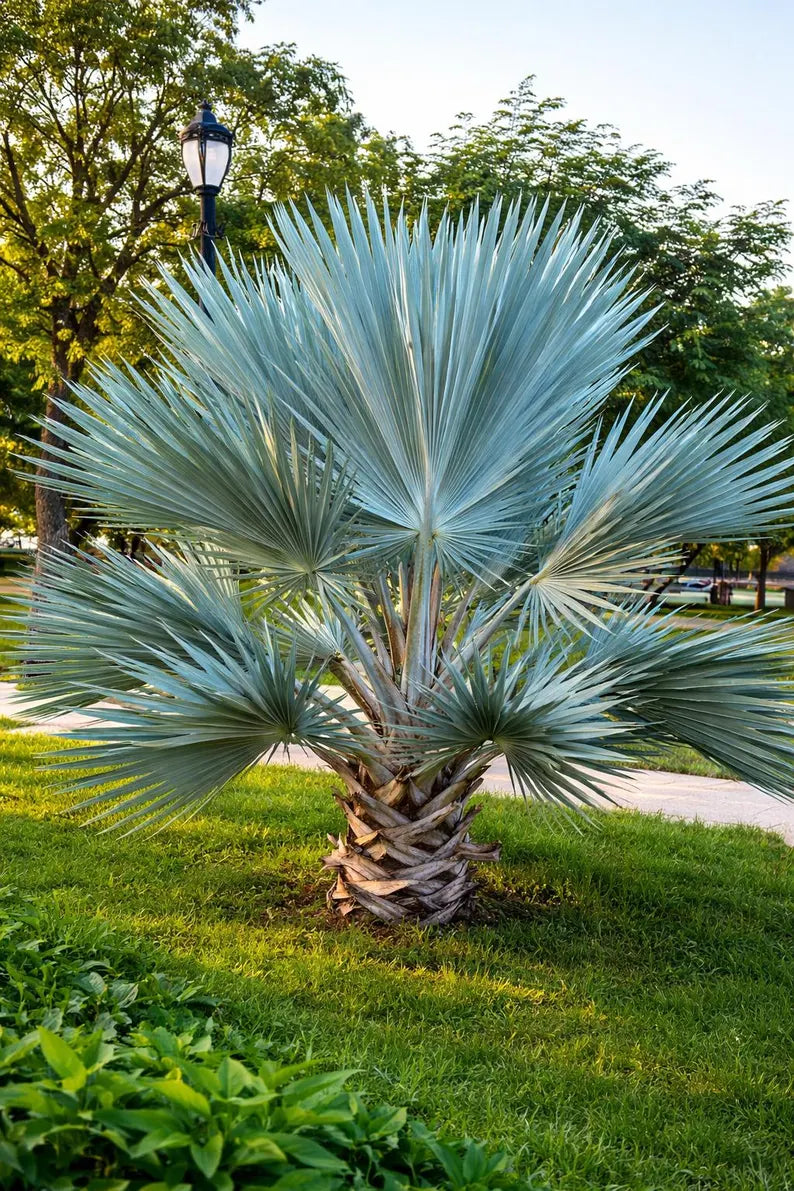
Mexican Blue Hesper Palm Tree Seeds (Brahea armata) – Cold Hardy Blue Fan Palm Tropical Ornamental
Mexican Blue Hesper Palm Tree Seeds (Brahea armata) – Cold Hardy Blue Fan Palm Tropical Ornamental
Couldn't load pickup availability
MEXICAN BLUE HESPER FAN PALM TREE SEEDS (Brahea armata)
The Mexican Blue Fan Palm (Brahea armata), also known as the Blue Hesper Palm or “Grey Goddess,” is one of the most striking ornamental palms in the world, prized for its silvery-blue fan-shaped foliage and extreme drought tolerance. Native to Baja California and northern Mexico, this palm is widely used in desert and tropical-style landscaping due to its dramatic color and architectural form.
This slow to moderate growing palm develops a single gray trunk that can reach up to 40 feet tall in ideal conditions, topped with a crown of rigid, fan-shaped fronds that range in color from powdery blue-gray to silvery turquoise. The trunk is ringed with old leaf scars, giving it a textured and sculptural appearance.
In summer, mature palms produce long arching flower stalks up to 3 feet in length, bearing clusters of fragrant white to cream-colored flowers. These are followed by small round fruits containing a single seed, which are attractive to wildlife.
🌱 Growing & Care Information
Light: Full sun preferred
Soil: Well-drained sandy or rocky soil
Water: Low; highly drought tolerant once established
Growth: Slow-growing ornamental palm
Climate: Extremely heat, wind, and cold tolerant for a palm species
Brahea armata is known for its exceptional resilience, tolerating heat, drought, wind, and short periods of cold down to approximately 15–18°F, making it one of the hardiest blue palms available for landscape use.
🌿 Why Grow Mexican Blue Fan Palm?
• One of the bluest palms in the world
• Extremely drought and heat tolerant
• Award-winning ornamental landscape palm
• Striking architectural focal point tree
• Suitable for desert, coastal, and container planting
USDA Hardiness Zones: 8a–11
Blue Palm Germination:
Due to the often slow and uneven germination of palm seeds, there has been a great deal of interest in any pre plant treatments that might speed germination or result in more even rates of germination. Substrates must be well-drained, yet have some moisture-holding capacity. A pattern of alternate extremes of dryness and wetness is detrimental to palm seeds during germination.
1) To avoid doing an acid soak, Aggressively Sand the hard seed shell so water can permeate into the seeds.
2) Soak the palm seeds in water for 5 to 7 days. Used distilled water and it is highly advisable to change the water daily. The seed must be planted immediately after the treatment, as storage following water soaking may induce a secondary dormancy.
3) Use a heated propagator to keep the soil at 91-97 F for Optimal results.
4) Press seed into well draining seed starter mix halfway leaving a bit of the top exposed. Keep uniform moisture during the initial stages. Not too wet, & Not too dry. Keep moist.
5) Patience will be needed as with any Tropical or Exotic, germination is erratic. Some may germinate in 2-3 weeks, while most will take up to several months. Following these germination steps will greatly increase the speed of germination.
Germinación de la palma azul:
Debido a la germinación a menudo lenta y desigual de las semillas de palma, ha habido un gran interés en cualquier tratamiento previo a la siembra que pueda acelerar la germinación o dar como resultado tasas de germinación más uniformes. Los sustratos deben estar bien drenados, pero tener cierta capacidad de retención de humedad. Un patrón de extremos alternos de sequedad y humedad es perjudicial para las semillas de palma durante la germinación.
1) Para evitar un remojo ácido, lije agresivamente la cáscara dura de la semilla para que el agua pueda penetrar en las semillas.
2) Remoje las semillas de palma en agua durante 5 a 7 días. Use agua destilada y es muy recomendable cambiar el agua a diario. La semilla debe plantarse inmediatamente después del tratamiento, ya que el almacenamiento después del remojo en agua puede inducir una latencia secundaria.
3) Use un propagador calentado para mantener el suelo a 91-97 F para obtener resultados óptimos.
4) Presione la semilla en una mezcla de semillas inicial con buen drenaje hasta la mitad dejando un poco de la parte superior expuesta. Mantenga una humedad uniforme durante las etapas iniciales. Ni demasiado húmedo ni demasiado seco. Manténgalo húmedo.
5) Se necesitará paciencia. Como con cualquier planta tropical o exótica, la germinación es errática. Algunas pueden germinar en 2 o 3 semanas, mientras que la mayoría tardará varios meses. Si sigue estos pasos, aumentará considerablemente la velocidad de germinación.
Share