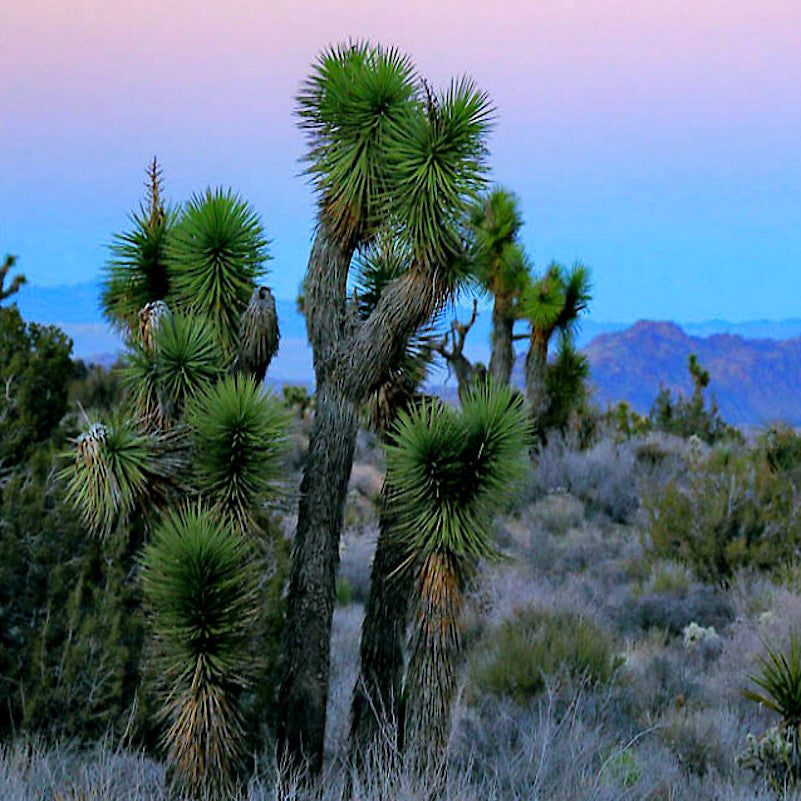
Joshua Tree Seeds (Yucca brevifolia) – Rare Desert Yucca Succulent Tree Cactus Plant
Joshua Tree Seeds (Yucca brevifolia) – Rare Desert Yucca Succulent Tree Cactus Plant
Couldn't load pickup availability
JOSHUA TREE PALM TREE SEEDS (Yucca brevifolia)
The Joshua Tree (Yucca brevifolia) is an iconic evergreen plant native to the Mojave Desert of the Southwestern United States, instantly recognizable for its unique branching form and extreme desert resilience. Often called the largest yucca species, this slow-growing desert tree has become a symbol of rugged arid landscapes and is highly valued in xeriscaping and collector gardens.
This striking plant can reach heights of 30 feet or more, developing thick, branching arms covered in stiff, sword-like leaves. Its unusual sculptural form makes it one of the most distinctive desert plants in the world.
In spring, mature Joshua Trees produce clusters of creamy-white, bell-shaped flowers that emerge at the ends of tall panicles. These flowers develop into light green seed pods and provide an important seasonal food source for pollinators, birds, and small desert wildlife.
Adapted to extreme conditions, Joshua Trees thrive in poor, rocky, sandy soils and environments with long, hot, dry summers and cold winters. They are extremely drought tolerant but do not tolerate high humidity or excessive rainfall.
🌱 Growing & Care Information
Light: Full sun required
Soil: Very well-drained, sandy or rocky soil
Water: Very low; drought tolerant once established
Growth: Extremely slow-growing evergreen desert plant
Climate: Best suited for hot, arid desert environments
Joshua Trees are uniquely adapted to survive temperature extremes and are ideal for desert landscapes, rock gardens, and xeriscaping designs.
🌿 Why Grow Joshua Tree?
• Iconic Mojave Desert landmark plant
• Extremely drought and heat tolerant
• Highly sculptural ornamental form
• Supports desert wildlife and pollinators
• Perfect for xeriscape and arid landscapes
USDA Hardiness Zones: 6–10
Joshua Germination:
1) Pour water at 90 degrees F over seeds, and let them soak overnight.
2) Use a 4 inch pot with adequate draining holes and fill with a commercial cactus starting mix. Water fully, and allow to fully drain.
3) Use a heated propagator mat set to a constant 75 degrees during the day, while letting temperatures drop to 60-65 degrees F at night. Simply turn off the heating mat at night to achieve alternating temperatures which mimic their natural conditions.
4) Slightly cover seeds with 1/8" of commercial cactus starting mix. Use a spray bottle to mist until moist being sure not make wet.
5) Keep in a bright location, or use a grow light.
6) Germination is erratic and can occur within a few weeks up to 2 months so don't toss out any that don't sprout quickly. They're still good and just need a bit more time.
"Please Contact us First if You Need Anything"
Germinación de Joshua:
1) Vierta agua a 90 grados F sobre las semillas y déjelas en remojo durante la noche.
2) Use una maceta de 4 pulgadas con orificios de drenaje adecuados y llénela con una mezcla comercial para iniciar cactus. Riegue completamente y deje que se escurra por completo.
3) Use una estera de propagación calentada a una temperatura constante de 75 grados durante el día, mientras deja que las temperaturas bajen a 60-65 grados F por la noche. Simplemente apague la estera calefactora por la noche para lograr temperaturas alternas que imiten sus condiciones naturales.
4) Cubra ligeramente las semillas con 1/8" de mezcla comercial para iniciar cactus. Use una botella rociadora para rociar hasta que estén húmedas, asegurándose de no mojarlas.
5) Manténgalas en un lugar luminoso o use una luz de cultivo.
6) La germinación es errática y puede ocurrir en unas pocas semanas hasta 2 meses, así que no deseche las que no broten rápidamente. Todavía están buenas y solo necesitan un poco más de tiempo.
"Comuníquese con nosotros primero si necesita algo"
Share