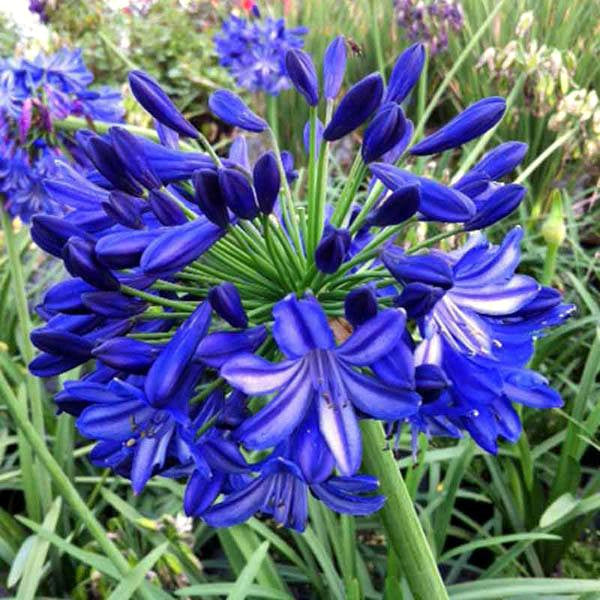
Dwarf Blue Lily of the Nile Seeds (Agapanthus ‘Peter Pan’) Compact Tropical Flowering - Blue Agapanthus Plant
Dwarf Blue Lily of the Nile Seeds (Agapanthus ‘Peter Pan’) Compact Tropical Flowering - Blue Agapanthus Plant
Couldn't load pickup availability
Dwarf Blue Lily of the Nile Seeds (Agapanthus ‘Peter Pan’)
The Agapanthus africanus ‘Peter Pan’, commonly known as Dwarf Blue Lily of the Nile or African Lily, is a compact ornamental perennial prized for its graceful clusters of soft blue trumpet-shaped flowers and neat mounding foliage. This dwarf Agapanthus variety is especially popular for borders, patio containers, walkways, and indoor decorative planting due to its manageable size and long-lasting floral display.
Known for producing elegant rounded clusters of pale blue blooms held above dense green strap-like foliage, the Peter Pan variety creates a refined tropical appearance without becoming overly large. Its flowers attract butterflies and birds, making it an excellent addition to pollinator-friendly gardens and ornamental landscapes.
Unlike larger Agapanthus varieties, this compact form typically grows around 10–12 inches tall, making it ideal for edging pathways, poolside plantings, small gardens, and decorative pots. It performs exceptionally well in containers and can easily be overwintered indoors in colder climates.
This hardy perennial blooms during the warm season and is widely appreciated for its low maintenance requirements and reliable flowering habit when provided with moderate moisture and bright light.
🌱 Growing & Care Information
Light: Full sun to partial shade
Soil: Well-draining fertile soil
Water: Moderate; prefers evenly moist soil
Growth: Compact clumping perennial
Climate: Warm temperate and subtropical climates
Dwarf Lily of the Nile grows especially well in containers and patio planters. In colder regions, plants can be brought indoors during winter for protection from freezing temperatures.
🌿 Why Grow Dwarf Blue Lily of the Nile?
• Compact dwarf Agapanthus variety
• Beautiful pale blue flower clusters
• Excellent border and container plant
• Attracts butterflies and birds
• Great indoor and patio ornamental plant
• Long-lasting cut flower potential
• Easy-care perennial with reliable blooms
• Perfect for small gardens and walkways
USDA Hardiness Zones: 8–11
Dwarf Blue Lily of the Nile Germination:
1) Fill a planting tray with good quality, compost-based potting mix. Add a small amount of perlite to promote drainage. (Be sure the tray has drainage holes in the bottom.
2) Sprinkle agapanthus seeds on the potting mix. Cover the seeds with no more than ¼-inch (0.5 cm.) of the potting mix. Alternatively, cover the seeds with a thin layer of coarse sand or horticultural grit.
3) Water the trays slowly until the potting mix is lightly moist but not soaking wet. Place the tray in a warm area where the seeds will be exposed to sunlight for at least six hours per day and be sure to use a heated propagator to keep the temperature around 75 degrees.
4) Water lightly whenever the surface of the potting mix is dry. Be careful not to overwater.
5) Move the trays to a cool, bright area after the seeds germinate, which usually takes about a month. Transplant the seedlings into small, individual pots when the seedlings are big enough to handle.
6) Cover the potting mix with a thin layer of sharp grit or coarse, clean sand.
"Please Contact us First if you need Anything"
Germinación del lirio azul del Nilo enano:
1) Llene una bandeja de plantación con una mezcla para macetas de buena calidad a base de abono. Agregue una pequeña cantidad de perlita para promover el drenaje. (Asegúrese de que la bandeja tenga orificios de drenaje en el fondo.
2) Espolvoree las semillas de agapanto en la mezcla para macetas. Cubra las semillas con no más de ¼ de pulgada (0,5 cm) de la mezcla para macetas. Alternativamente, cubra las semillas con una capa fina de arena gruesa o gravilla para horticultura.
3) Riegue las bandejas lentamente hasta que la mezcla para macetas esté ligeramente húmeda pero no empapada. Coloque la bandeja en un área cálida donde las semillas estén expuestas a la luz solar durante al menos seis horas por día y asegúrese de usar un propagador calentado para mantener la temperatura alrededor de 75 grados.
4) Riegue ligeramente siempre que la superficie de la mezcla para macetas esté seca. Tenga cuidado de no regar demasiado.
5) Mueva las bandejas a un área fresca y luminosa después de que las semillas germinen, lo que generalmente demora aproximadamente un mes. Trasplanta las plántulas en macetas pequeñas individuales cuando sean lo suficientemente grandes como para manipularlas.
6) Cubre la tierra para macetas con una fina capa de arena gruesa y limpia.
"Comunícate con nosotros primero si necesitas algo"
Share