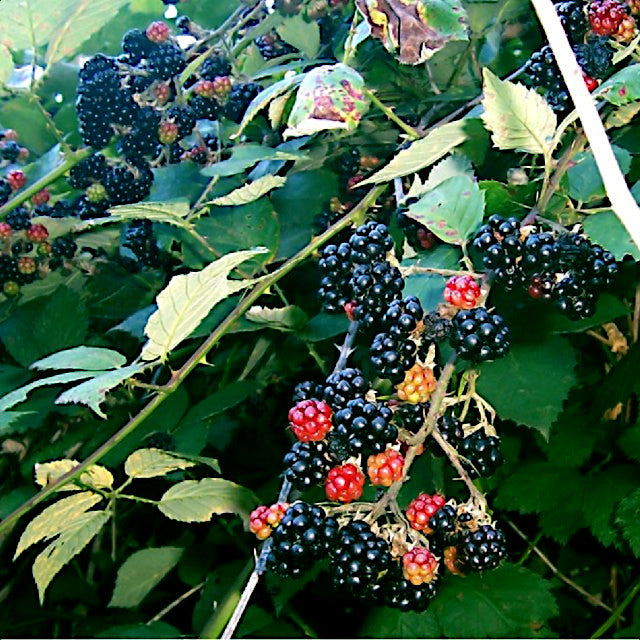
Blackberry Bush Seeds (Rubus allegheniensis) Hardy Wild Edible Fruit Plant
Blackberry Bush Seeds (Rubus allegheniensis) Hardy Wild Edible Fruit Plant
Couldn't load pickup availability
Blackberry Bush Seeds (Rubus allegheniensis)
The Rubus allegheniensis Blackberry Bush, commonly known as Allegheny Blackberry, is a highly resilient native North American fruiting bramble prized for its sweet edible berries, extreme cold hardiness, and vigorous growth habit. This wild blackberry species is widely valued for naturalized plantings, edible landscapes, and wildlife-friendly gardens.
Known for its arching, thorny canes, Blackberry forms dense multi-stemmed thickets that often spread into large colonies over time. The canes are armed with stout spines and produce clusters of white flowers followed by juicy black berries that ripen in summer. The fruit is highly attractive to birds, small mammals, and foragers alike.
The berries are commonly used fresh, or for jams, jellies, pies, syrups, and preserves.
🌱 Growing & Care Information
Light: Full sun to partial shade
Soil: Well-drained loamy or sandy soil rich in organic matter
Water: Moderate; drought tolerant once established
Growth: Fast-growing perennial fruiting bramble
Climate: Extremely cold hardy temperate climates
Blackberries perform best in slightly acidic soils (pH 5.5–7.0) with regular moisture during fruiting for optimal berry production. Once established, they are highly drought tolerant but will produce significantly higher yields with consistent watering.
This species spreads readily and is often used for natural hedgerows, wildlife habitats, and edible barrier plantings due to its dense thorny growth habit.
🌿 Why Grow Blackberry Bush?
• Produces sweet edible wild blackberries
• Extremely cold hardy (Zone 3 tolerant)
• Excellent wildlife food plant
• Fast-spreading natural hedge plant
• Great for jams, pies, and preserves
• Drought tolerant once established
• Ideal for naturalized edible landscapes
Blackberry remains one of the most reliable and productive wild fruiting shrubs for cold climates and natural food forest systems.
USDA Hardiness Zones: 3–7
Blackberry Germination:
1) Use a thermos to soak seeds in very warm water for 24hrs.
2) Cold stratify by placing seeds into a zip lock bag of moist peat moss or vermiculite, and place inside the fridge for 90 days. This will break the seeds dormancy and will allow them to germinate. Periodically check to make sure they do not dry out. Use a spray bottle to mist them so they're not overly wet as that can cause the small seeds to rot.
3) Plant seeds no more than 1/8" deep into a sterile seed starting mix. Keep "slightly moist" by misting with a spray bottle.
4) Use a heated propagator mat to keep the soil at 75 degrees F. during the day. Turn off the at night to drop the temperature to 68 degrees or less. This creates alternating temperatures which mimics their natural conditions in the wild which greatly improves germination rates.
5) Expect germination within 2-3 weeks.
Germinación de moras:
1) Use un termo para remojar las semillas en agua muy caliente durante 24 horas.
2) Estratifique en frío colocando las semillas en una bolsa con cierre hermético con turba húmeda o vermiculita y colóquela en el refrigerador durante 90 días. Esto romperá la latencia de las semillas y les permitirá germinar. Revíselas periódicamente para asegurarse de que no se sequen. Use una botella rociadora para rociarlas para que no estén demasiado mojadas, ya que eso puede hacer que las semillas pequeñas se pudran.
3) Plante las semillas a no más de 1/8" de profundidad en una mezcla estéril para semillas iniciales. Manténgalas "ligeramente húmedas" rociándolas con una botella rociadora.
4) Use una estera de propagación calentada para mantener la tierra a 75 grados F durante el día. Apague la calefacción por la noche para bajar la temperatura a 68 grados o menos. Esto crea temperaturas alternas que imitan sus condiciones naturales en la naturaleza, lo que mejora en gran medida las tasas de germinación.
5) Espere la germinación dentro de 2 a 3 semanas.
Share