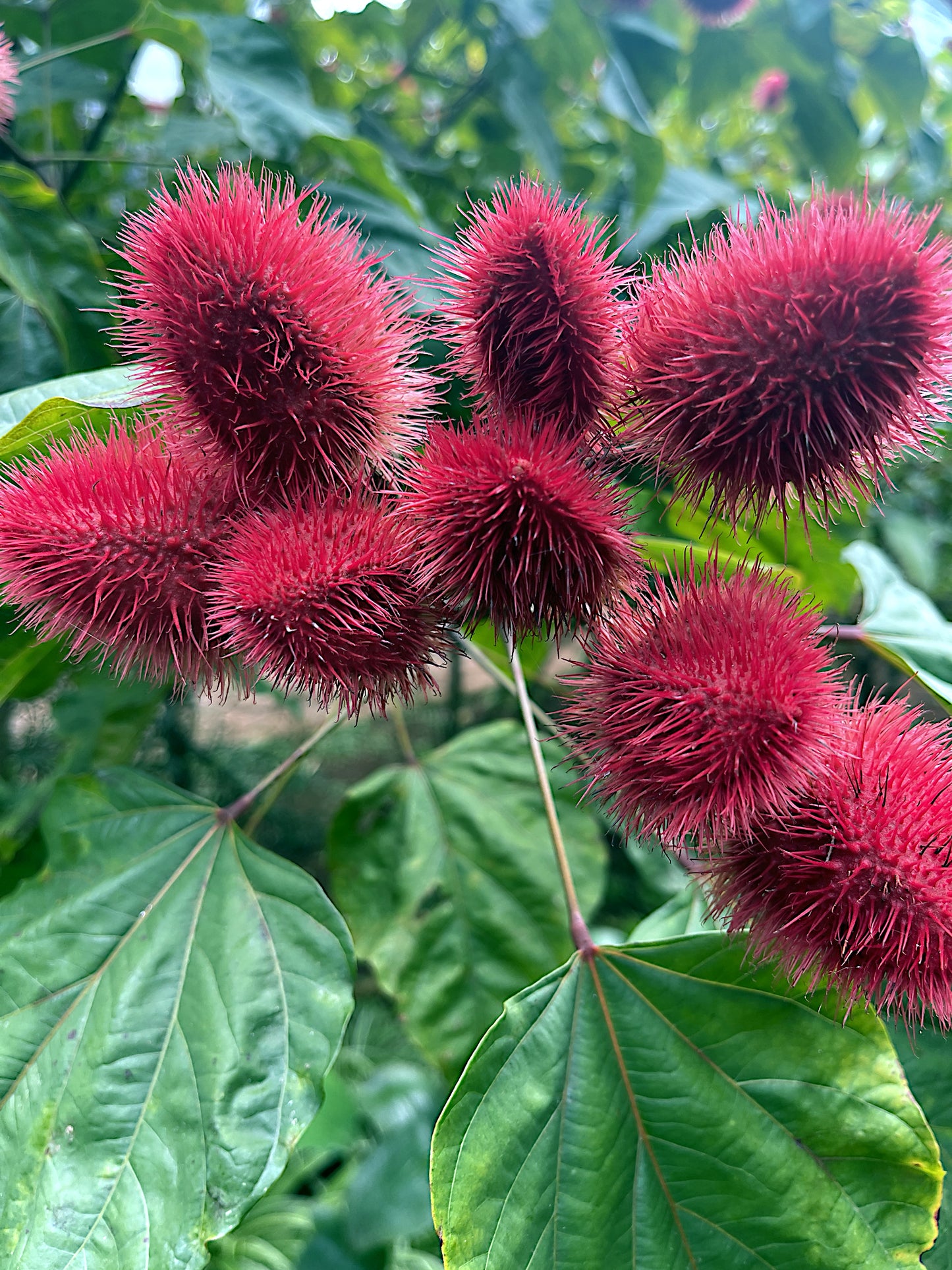
Annatto Dye Plant Seeds (Bixa orellana) Lipstick Tree | Natural Red Dye & Spice Plant | Tropical Ornamental Shrub
Annatto Dye Plant Seeds (Bixa orellana) Lipstick Tree | Natural Red Dye & Spice Plant | Tropical Ornamental Shrub
Couldn't load pickup availability
Annatto Dye Plant Seeds (Bixa orellana) Lipstick Tree
The Bixa orellana, commonly known as Annatto or Lipstick Tree, is a fast-growing tropical evergreen shrub valued for its ornamental pink flowers, colorful spiny seed capsules, and natural dye-producing seeds. Native to Central and South America, this tropical plant is widely cultivated for both ornamental and practical uses.
Annatto produces attractive soft pink flowers approximately 2 inches wide, borne in terminal branched clusters. These blooms are followed by distinctive bristly, spiny seed pods that mature from reddish-brown to bright red. When ripe, the capsules split open to reveal seeds coated in a vibrant orange-red pulp.
The seed coating is the source of annatto dye, a natural pigment historically used by indigenous cultures for body paint, textiles, cosmetics, and food coloring. Today, it is still widely used in the food industry to naturally color products such as cheese, butter, rice, and spices.
This tropical species grows as a large shrub or small tree, typically reaching 6–12 feet tall in cultivation, though it can reach up to 20–30 feet in ideal warm climates. It has broad, heart-shaped leaves and thrives in full sun with consistently warm temperatures year-round.
Annatto is highly sensitive to cold and must be grown in frost-free environments or kept as a greenhouse/indoor plant in cooler regions. It can be pruned to maintain size, making it suitable for container growing in warm, controlled environments.
🌱 Growing & Care Information
Light: Full sun
Soil: Well-draining, fertile soil
Water: Moderate; keep consistently warm and moist
Growth: Tropical evergreen shrub or small tree
Climate: Frost-free tropical/subtropical regions
This species requires stable warm temperatures and cannot tolerate cold or frost.
🌿 Why Grow Annatto Tree?
• Produces natural red-orange dye seeds
• Beautiful ornamental pink flowers
• Unique spiny decorative seed pods
• Historically used in cosmetics and food coloring
• Tropical evergreen landscape shrub
• Can be grown in containers and pruned
• Fast-growing in warm climates
• Multi-purpose dye, spice, and ornamental plant
USDA Hardiness Zones: 10–12
Annatto Germination:
1) Pour seeds into warm water and let them soak for 7 days. Use a thermos to keep the water warm, and be sure to change water daily.
2) Use a commercial peat seed starting mix and keep the soil temperature at 78-80 degrees F. with a heated propagator mat.
3) Plant the seeds no more than 1/4" inch deep as light is needed for germination. A grow lamp, or sunny window is best.
4) Cover with plastic to retain a high humidity level. Uncover plastic periodically to keep them moist, not wet. Misting with a spray bottle works the best.
5) Patience is needed as with any tropical, germination is erratic and can be expected anywhere between 30-180 days.
6) After the first ones sprout, don't toss out the rest as they are still good and only need more time. It is the natural process of nature.
Germinación del achiote:
1) Vierta las semillas en agua tibia y déjelas en remojo durante 7 días. Use un termo para mantener el agua tibia y asegúrese de cambiar el agua a diario.
2) Use una mezcla comercial de turba para semillas y mantenga la temperatura del suelo a 78-80 grados F con una estera de propagación calentada.
3) Plante las semillas a no más de 1/4 de pulgada de profundidad ya que se necesita luz para la germinación. Una lámpara de cultivo o una ventana soleada es lo mejor.
4) Cubra con plástico para mantener un alto nivel de humedad. Destape el plástico periódicamente para mantenerlas húmedas, no mojadas. Rocíe con una botella rociadora lo mejor.
5) Se necesita paciencia como con cualquier planta tropical, la germinación es errática y se puede esperar entre 30 y 180 días.
6) Después de que broten las primeras, no deseche el resto ya que todavía están buenas y solo necesitan más tiempo. Es el proceso natural de la naturaleza.
Share